The passage of Robin Williams left millions of people with a broken heart, but no one suffered as much as the children of the actor.
But Zelda Williams came in a rare appearance on Friday with his mother Marsha Garces to Noble Awards in Beverly Hills.
And although, of course, wants to keep the memory of her father alive - she admits is basically unlikely to ever forget the bigger man than life.
[Related: Zelda Williams Legacy Father recalls Robin Williams' In his first sit-down interview since his death]
Here's what he said:
"For me it's easy to remember someone who is impossible to forget."
Zelda also talked about back in the spotlight and like something I felt I had to do was. She explained:
"It is not difficult, it's just a strange feeling. Nothing happens, that will be fine, but it's a transition. It is recognizing that you have to stop feeling that there is a world out there, because for a short period of time doesn "t."
You may remember Zelda has a beautiful tattoo of a hummingbird in memory of his father, and she explained that the tattoo to her, saying:
"If you saw it fly, and if you know a bit about them, are impossible to keep in one place. Whenever people see them not as they say, 'Oh, my God, a hawk for a hummingbird -flor, and that was the reaction that my father has, kids, fans, old people, and that's what always hummingbirds meant to me. "
Robin Williams and Marsha Garces really did a wonderful job with their children and Zelda is a shining example of his father.
She is only 25 and yet she is so wise at this point in your life. Robin Williams would be very proud of it.
The world of digital imaging and photo editing is changing. Photographers don't just need image-manipulation tools any more, they also need programs that can organise, search and share an ever-growing library of photos.
And as more and more of us shoot raw files, the quality of the raw conversion process grows ever more important. All raw converters are not the same, and Adobe has some serious rivals here.
That's not all. Even though Photoshop might still be the best image-editor, an image-editor in itself may not longer be enough for the things we want to do with our photos today. We don't necessarily want to sit in front of a single image for hours on end surrounded by manuals. More often than not, we develop a personal style we want to apply with a single click, to dozens of photos at a time – and there are much better programs for this than Photoshop.
So here are our top six Mac and PC photo editing applications – programs which are genuinely cross--platform and which run on either machine. They include regular image editors like Photoshop and Elements, image cataloguing specialists like Lightroom and all-out raw converters like DxO Optics Pro.
Our verdict might not be that much of a surprise, maybe, but it has a twist. We don't think there is a single winner, and we think that Photoshop itself does not do enough on its own. Instead, we've gone for an image-editing double-act that's both integrated and affordable, thanks to Adobe's latest software subscription plans.
Subscription software is still highly controversial, but the cost calculations are compelling. You can get both our winning software tools for less than £9/US$10 per month, based on an annual subscription.
Adobe created a storm of controversy when it swapped Photoshop over from a regular 'perpetual' licence (you pay once then use the software forever) to a subscription scheme where you pay a monthly/annual fee to use it. If you stop paying the subscription, you lose the software.
In practice, the sky hasn't fallen in, it's proved a good deal financially, and although there are still questions over how you open/work with your Photoshop files when you stop your subscription, the transition has proved pretty painless.The upside is that you get automatic, free updates for as long as you subscribe – and the last one was when Adobe released Photoshop CC 2014.
Photoshop is both more sophisticated and more limited than some of the other programs in this list. For layers, masks, selections, retouching and complex, multi-step imaging processes, it's impossible to beat. It's enormously powerful, yet manages to present these tools in a remarkably clean, fast and efficient interface.
On the downside, it doesn't offer proper image cataloguing tools (Adobe Bridge is really just a glorified folder browser), so you need another tool for that. And it doesn't offer a library of single-click creative effects – for this you need extra plug-ins, such as the Google Nik Collection, OnOne Perfect Photo Suite or Topaz Effects. Photoshop is like a giant box of spanners – it has all the tools you could possibly want, but it's not going to show you how to fix your car.
Lightroom is a new kind of image-editing tool, combining an image cataloguing and management database with 'non-destructive' editing tools. It means that you can make non-permanent adjustments to an image which are visible within Lightroom but only made permanent when you export a new version of the picture with the adjustments applied – your original photos are never modified.
Lightroom's organising tools are very powerful. It uses a central image database, or 'library', so it's much faster and more flexible than a simple file browsing tool like Adobe Bridge. The larger your photo collection becomes, the more useful you'll find a database tool like this.
The image-editing tools are the same as those in Adobe Camera Raw, but presented in a different interface. They can't do everything – for selections, layers, masks and many more complex effects you'll still need a program like Photoshop – but for everyday image enhancements and picture 'styles', Lightroom is perfect.
Since GoPro launched its latest camera range in the GoPro Hero4 the photos being created are stunning. With it comes new 4K video speeds of 30 frames per second, a rear touchscreen display and two times faster image processing. The camera remains largely the same at 12-megapixels with an f/2.8 aperture - but the photos appearing online are breath-taking.
GoPro's decision to keep the camera the same shows that it's already very good. Thanks to the camera, and video stills, the internet is awash with stunning images from GoPros around the world. Finding them all is a bit of a job, so we've done it for you.
From surfing and skydiving to animal close-ups and stunning scenery, this gallery has some breath taking images that we only get to see thanks to the GoPro. No longer are rare wildlife photos restricted to pros who spend years awaiting the perfect shot – now thousands of GoPros are scanning the world all at once, constantly. We're only ever going to get more amazing shots to wow us.
For now enjoy this selection found mainly from Facebook, Flickr, GoPro and Photobucket.
If you've got photos taken on your GoPro you wish to submit then please or .
Representatives from 13 Asian countries committed to immediate action to stamp out poaching at the conclusion of a four-day symposium hosted by the Nepal government in Kathmandu from February 2-6, 2015.
The Symposium: Towards Zero Poaching in Asia adopted five recommendations:
Swift and decisive action to elevate the importance and effectiveness of antipoaching initiatives and cooperation among all relevant ministries, departments and agencies within their borders, while at the same time strengthening international cooperation in the face of this serious criminal activity.
Adoption of the Zero Poaching Tool Kit and assessment of current antipoaching responses to determine improvements and close serious gaps.
Increase and improve collaboration as a successful antipoaching response is critically dependant on effectively engaging a diverse number of shareholders
Improve standards, training and support for rangers, other frontline staff and prosecutors.
Commit to identifying a Zero Poaching national contact point to effectively coordinate transboundary efforts to stop poaching.
Tika Ram Adhikari, Director General of Nepal’s Department of Wildlife Conservation and Soil Conservation, said: “Nepal was proud to host this vital conversation in Asia because we recognize that poaching is robbing us of our wildlife wealth, which includes tigers, rhinos and elephants. We cannot allow wildlife crime to continue to wrap its tentacles deeper into the region. Our individual efforts may win us a few battles, but we can only win the war if Asia presents a united front to stop the poaching, end the trafficking and wipe out demand.”
Mike Baltzer, Leader, WWF Tigers Alive Initiative, said: “This is the beginning of the end for poaching across Asia. WWF is proud to have supported this landmark meeting and is committed to be part of the new determined movement for Zero Poaching in Asia.”
Nepal was the natural host for the symposium having achieved zero poaching for two years in the past four years. At the symposium, representatives from local communities, protected areas as well as enforcement agencies shared their lessons lea
At the closing ceremony, Nepal’s legendary Chitwan National Park (CNP) also became the first global site to be accredited as Conservation Assured Tiger Standard (CA|TS).Despite the threats that CNP faces, the protected area has seen an increasingly effective management and protection regime. This further demonstrates the commitment of Nepal towards zero poaching.
Thirteen Asian countries participated in the symposium: Bangladesh, Cambodia, China, Viet Nam, Malaysia, Russia, Indonesia, Myanmar, Thailand, Nepal, India, Bhutan, and Lao PDR. Partner NGOs and other organisations included IUCN, TRAFFIC, CITES, UN Office on Drugs and Crime, US Department of Justice, SMART Partnership and Southern African Wildlife College.
WWF co-hosted the symposium with Global Tiger Forum, National Trust for Nature Conservation and the South Asian Wildlife Enforcement Network.
The symposium provides valuable direction on tackling poaching in advance of the Kasane Conference on the Illegal Wildlife Trade to be hosted by the Botswana government on 25th March 2015. This meeting follows the London Conference on the Illegal Wildlife Trade hosted by the UK government in February 2014, where 41 governments committed to taking “decisive and urgent action….” through the agreed declaration.
Not content with providing show visitors with a free massage, Olympus also had a small laboratory where white-coated technicians would clean your Olympus camera while you waited. A quick scrub with a toothbrush dealt with that tricky area round the mode dial, a careful wipe with a lens cloth put the sparkle back in your glassware and some delicate work with a blower brush and a pair of tweezers took care of any spots, hairs or other debris on the sensor surface.
We did pick up a particularly useful tip. There wasn't a sensor swab in sight for the sensor-cleaning part. Instead, the technicians were using a fresh little square of rice paper picked up with the tweezers, wrapped around the end and dabbed with a spot of special sensor-cleaning fluid. Interesting...
Now here's a smart idea. It's a USB storage device with not one plug but two. The aluminium casing slides across to reveal an Apple Lightning connector on the other side, and you can use this handy gadget to transfer photos (or music) from your iPhone or iPad to your computer. It's all a bit old-school, and you could do this using iCloud or a cable connection too, but the iStick is quick and simple and easy to understand, especially for photographers. It's also a way to back up your files while you're out and about or just to gain a little extra storage space on your device.
You start by plugging the iStick into your iOS device and this automatically initiates the app download. You can then use the app to choose the files you want to copy across to the iStick. It comes in different capacities, from 8Gb (£50) to 128Gb (£200) and while the makers acknowledge there are similar devices out there already, this is not only the cheapest, it's the first to be made from aluminium. You can find out more at the .
We've seen all sorts of devices, cameras and software for creating panoramic images, including 360-degree rotating cameras, panoramic heads and VR stitching software. But here's a clever product that takes just one shot with a regular camera that doesn't even need to move – and the maker, , has just produced a Go Pro version.
It's rather clever. The camera is mounted facing upwards into a specially-shaped circular mirror. It produces a full 360-degree circular image that can then be edited by the software into a regular horizontal panoramic image. The key point with the Go Pro version is that you can shoot from a single viewpoint, and then rotate the view afterwards to change the viewpoint through a full 360 degrees.
The regular version is much larger, using a specially made tubular mount with the camera at the base and the mirror at the top. There will be some quality loss that stems from extracting rectangular segments from the circular image, but this is balanced by the sheer convenience of being able to capture a full 360-degree image with a single exposure and no panning or stitching.
It's not so easy to get into astrophotography. The usual route is to start with a telescope then work out how to add a motorised drive to your tripod and find an adaptor to fit your camera. But the Polarie Star Tracker, from , offers a much simpler and cheaper solution for photographers – essentially, this is for photographers who want to shoot star fields rather than astronomers who want to take photos.
It's disarmingly simple. You fit the Polarie to your tripod head, adjusting the angle so that it's pointing at the pole star (Polaris) – you can get an spotting scope for this. This sets the Star Tracker at the right angle to follow the arcing movement of the stars across the sky.
You then attach your camera to the Star Tracker via a second tripod head, start the motor and start your time exposure. It looks brilliantly simple, and was on sale at the show for £319, including the Polar Scope. But what if (we hear you ask) you're in the southern hemisphere, where you can't see the pole star? Simple – there's a switch on the base for 'S' (southern) and 'N' (northern) hemispheres.
Professional studio lighting is always a big crowd-puller at The Photography Show, but there are signs that big LED panels are gaining ground. Flash produces a short, intense burst of light that's tricky for non-experts to work with because you only really see the effect once the picture has been taken. But LED panels produce 'continuous' lighting that's less intense but lets you check the exposure and judge the lighting effect much more easily. This was taken at the stand.
LED panels give out far less heat than traditional continuous studio lighting such as tungsten, halogen or fluorescent lamps, they use less power and they can be run outdoors from battery packs. They're perfect, of course, for video, where flash units are useless.
Tenba makes camera bags, as do many other manufacturers, but Tenba has chosen a Japanese sumo star as its marketing mascot and gave us some of the best laughs of the show. He featured in a bunch of publicity shoots taking pictures in a jungle, pulling wheelies on a mountain bike and wrestling with camera cables.
Tenba also had a backpack designed especially for GoPro users, which was handy because we were presenting talks on action cams daily on the TechRadar Mobileography stand – Marketing Manager Peter Waisnor even let us borrow one for our demonstration. It has compartments designed specifically for GoPro cameras, mounts, backs and tools.
Franzis is big in Germany but unknown (to us) in the UK. It publishes its own '' software as well as distributing more familiar brands, including , in Germany. We spoke to Senior Produktmanager Ulf Schulmeyer who gave us a run-down on his company's products and a disc containing all five programs – look out for a full review on TechRadar once we've tried them out.
They do sound interesting. 'Projects' is the name of the brand, and they're standalone image-editing apps for Mac and PC. They include HDR Projects, Denoise Projects, Focus Projects (focus stacking), Black and White Projects and Photo Works Projects (general image effects).
The Panasonic stand was the setting for a whole bunch of weird and wonderful set pieces including sparring boxers and these athletic acrobatics. Honestly, it's not so easy to hold someone over your head with one arm. (We tried this back at the office and it didn't go well.)
There was a serous point. Around this mini-arena were lines of 4K Panasonic cameras, and visitors got to shoot 4K video and pull out 8-megapixel stills. The video is grabbed at 30fps, so effectively you're getting 2-3 times the frame rate of the best sports stills cameras.
Can you really get decent stills from video footage? It's not the sort of claim most photographers would believe, but Panasonic is deadly serious, and had large format prints to prove it. Not only that, they had photographers there who actually shoot 4K for stills, and for their own livelihood. We chatted to sports pro Ian Cook and portrait maestro Ross Grieve after the show and they couldn't stop talking about how good these stills were for their own work.
The Streetscape stage gave pro speakers a chance to teach some urban photography skills. Speakers included Panasonic 4K fan Ross Grieve, TechRadar opinionist Damien Demolder, James Madelin (who also presented 5 top tips for better phone photography on the TechRadar stand) and advertising photographer R.Cleveland Aaron talking about Light, Shapes and Space.
I just wish I hadn't lent them my car.
makes mid-high end video cameras, from the £699 Micro Four Thirds based Pocket Cinema Camera through 2.5K and 4K Production and Studio cameras. And to show visitors what these cameras can do and how they work, Blackmagic set up this surreal coffee bar complete with actors, props and lighting – then surrounded it on four sides with cameras. It was like filming an episode of Neighbours or Home and Away. Not that we've ever watched these programs. Ahem.
Full credit to Blackmagic for thinking up an innovative stand design that gave visitors plenty of room, and time, to try out the cameras. (And for making a video camera rig that looks like a prop from a Terminator film.) Video was a big theme at this year's show, and while some amateurs still don't like the idea of being force-fed video features on DSLRs, most pros are realising that video is going to be more and more important in the future.
The first thing you need to know about the Impossible Project Instant Lab Universal is that it produces Polaroid-style photos from your smartphone snaps. The second thing you need to know is that it's a camera, not a printer.
Unlike the rather disappointing Polaroid-branded Zink printers, the Instant Lab produces actual Polaroid-esque photographs. That's because Impossible Project cleverly bought Polaroid's remaining factory a few years ago in order to manufacture its own film, which is designed to work with vintage Polaroid cameras and, of course, the Instant Lab Universal.
The original Instant Lab was launched in 2013, but only worked with the iPhone 4, 5, 5S and iPod touch. The new Universal model, however, is designed to work with more devices thanks to new "touch location technology". This means it supports phones from Samsung, HTC and Google (Nexus), as well as the iPad. Screens need to be high-res (approximately 300ppi) and run on Android 4.0.3 (Ice Cream Sandwich) or above.
We've unleashed our inner hipster and have been testing the Lab using an iPhone 6, iPad Air 2 and the HTC One M8. It's a lot of fun, like a big kid's toy.
The Lab Universal sports a simple yet functional design, with a sturdy metal base along with a plastic bellows-style extendable turret with a phone cradle on top. The only controls you'll find are the latch for opening the film bay door at the bottom - where the film cartridges can be easily slipped in - along with an eject button to pop out the exposed photo.
To the top are three sensors on the cradle - representing the touch location technology part of things - used to detect when a phone is placed there. For larger devices, such as an iPad, these act as essential points to communicate with the app and let it know which portion of the screen is in play, then re-adjust the photo's placement on screen so the Lab can make a duplicate exposure of it.
A removable adaptor can be used with iPhones 4/4S/5/5S/5C, but for Android devices not everything is compatible just yet. The brand new HTC One M9 is one such unsupported example (we did try it out, but it was a no go). prior to purchase if you're concerned.
The dedicated Impossible Project app has been redesigned and includes a useful, if slightly sinister, audio commentary to guide you through the picture-taking process.
Using the app, you can take a picture or select one from your camera roll or Instagram account. You'll be given to the option to crop it, adjust contrast, gamma and hue, and then select the film stock that you're using.
Once the app instructs you, put your mobile device face down on the cradle (it's best to take your device out of its case), wait for the phone's flash to come on then pull out the shutter slide at the base of the Lab. This is pushed back in once the light has gone off and the shutter sound of a photo being taken is heard.
Next, you simply press the eject button and the photo pops out under a protective, roll-up sheet. Impossible film is extremely sensitive to light - far more so than vintage Polaroid film - so it's essential to shield it by immediately turning it over and letting it develop face down. The old trick of shaking it around in the air? That doesn't work with this film, and you're likely to ruin your picture if you try it.
The protective sheet is a tad delicate too, but it's an effective solution to the problem of light ruining the print. If you're using Impossible's film in a retro Polaroid camera instead, then there's no such protection, so you have to shield the photo with your hand as it comes out.
Impossible produces a selection of 600 for use with the Lab, including prints with the conventional square white frame, along with the choice of black, multicoloured, metallic or even circular frames.
Picture results vary (restricted, in part, to the smart device's screen resolution), but the clearer your original picture, the better the result from the Instant Lab.
Photos without additional filters applied to them tend to work best, as the Lab itself provides its own, genuine, Polaroid-esque filter. Having said that, some already filtered pictures can work well, especially ones that provide extra colour saturation and contrast.
Resulting images tend to get more washed-out, with nostalgically softened edges, so any particularly bleached-out or soft pictures will lose a lot of quality once printed.
In a world of Facebook, Twitter and Instagram, sometimes it makes a nice change to have a photo that you can actually hold in your hand or stick on the fridge.
The Instant Lab Universal isn't the cheapest way to get hard copies of your snaps (film cartridges cost around £17 for eight prints), but it certainly is fun - which is half the point of this product. The expanded compatibility since the previous model is great news for Android users too (and there's yet more to come).
We've embraced the Instant Lab Universal and produced some fun results that'll live on when that smartphone battery depletes. Polaroid fans and retro camera nuts will find a lot to like here. And hipsters, too, obviously.
The selfie craze is in full swing, with all manner of devices getting in on the action. The Fujifilm X-A2, , is the latest compact system to opt for a flip-forward screen. But does it strengthen the X-series line-up?
Handling the X-A2 for the first time at The Photography Show, Birmingham, and we're more impressed with the black finish than we are with the colour variants. The black doesn't utilise the faux leather with snakeskin-esque print, which we're not big fans of (). Instead it's a textured and solid exterior, despite its plasticky build quality.
As this is the most affordable entry-point into Fujifilm's system camera line-up, that's one of the biggest take-away points: unlike the high-end X-Pro1, and models, the X-A2 is all about being affordable, with a price tag of £419 with the 16-50mm lens included.
Its more playful selfie feature has moments of intelligence, others of questionable logic though. The way the 3-inch LCD screen flips around and can then be pulled further upwards on its bracket hinge is a clever way to clear the top plate protrusion of the camera so the screen is visible. But the panel isn't touch-sensitive, which for selfie-taking sakes doesn't make much sense - try handling the camera in one hand and reaching backwards for the shutter button and it feels wrong.
But that's unlikely to be the reason many will opt for this particular camera. It's all about price and, to an extent, looks. The shiny top panel with its exposure compensation and mode dials add to the old skool aesthetic, which is exactly what Fujifilm has built its X-series reputation on.
Lens-wise don't expect the 16-50mm to be outstanding - its f/3.5-5.6 maximum aperture limits the available light and control - and there's not the physical aperture ring of some of the better-specified XF-mount lenses. But you can upgrade if you wish, and there are plenty of pricier XF-mount optics out there to cater for upgrading.
However, and like its predecessor, the X-A2 sticks with a "normal" APS-C sensor, not the fancy-pants X-Trans CMOS II sensor of its superior cousins. Image quality is one and the same on paper - something we were limited to explore in its tethered-to-stand state - from the decent-enough 16-megapixel offering. That's befitting of the product's position in the range.
What is enhanced, however, is an updated autofocus system with Eye Detection AF to automatically focus on a subject's eyes for more precise portrait and selfie shots. That might go some way to countering the twisted-hand selfie stance then.
In terms of autofocus speed, as is typical with Fujifilm, the system isn't the very fastest of all available compact system cameras on the market, but it'll give the likes of Canon's EOS M a run for its money. Shame there's no touchscreen though, which we would have found handy when shooting the motorcycle setup on the Fujifilm stand at the show.
Despite its selfie feature not standing out in a busying market, the Fujifilm X-A2 makes itself noticed by the way it looks and, perhaps most importantly, how much it costs. It doesn't set the X-series alight - we're bigger fans of the plusher, better built models higher in the range - but it finds its own self-centred space. Ideal for those on a budget.
The selfie craze is in full swing, with all manner of devices getting in on the action. The Fujifilm X-A2, , is the latest compact system to opt for a flip-forward screen. But does it strengthen the X-series line-up?
Handling the X-A2 for the first time at The Photography Show, Birmingham, and we're more impressed with the black finish than we are with the colour variants. The black doesn't utilise the faux leather with snakeskin-esque print, which we're not big fans of (). Instead it's a textured and solid exterior, despite its plasticky build quality.
As this is the most affordable entry-point into Fujifilm's system camera line-up, that's one of the biggest take-away points: unlike the high-end X-Pro1, and models, the X-A2 is all about being affordable, with a price tag of £419 with the 16-50mm lens included.
Its more playful selfie feature has moments of intelligence, others of questionable logic though. The way the 3-inch LCD screen flips around and can then be pulled further upwards on its bracket hinge is a clever way to clear the top plate protrusion of the camera so the screen is visible. But the panel isn't touch-sensitive, which for selfie-taking sakes doesn't make much sense - try handling the camera in one hand and reaching backwards for the shutter button and it feels wrong.
But that's unlikely to be the reason many will opt for this particular camera. It's all about price and, to an extent, looks. The shiny top panel with its exposure compensation and mode dials add to the old skool aesthetic, which is exactly what Fujifilm has built its X-series reputation on.
Lens-wise don't expect the 16-50mm to be outstanding - its f/3.5-5.6 maximum aperture limits the available light and control - and there's not the physical aperture ring of some of the better-specified XF-mount lenses. But you can upgrade if you wish, and there are plenty of pricier XF-mount optics out there to cater for upgrading.
However, and like its predecessor, the X-A2 sticks with a "normal" APS-C sensor, not the fancy-pants X-Trans CMOS II sensor of its superior cousins. Image quality is one and the same on paper - something we were limited to explore in its tethered-to-stand state - from the decent-enough 16-megapixel offering. That's befitting of the product's position in the range.
What is enhanced, however, is an updated autofocus system with Eye Detection AF to automatically focus on a subject's eyes for more precise portrait and selfie shots. That might go some way to countering the twisted-hand selfie stance then.
In terms of autofocus speed, as is typical with Fujifilm, the system isn't the very fastest of all available compact system cameras on the market, but it'll give the likes of Canon's EOS M a run for its money. Shame there's no touchscreen though, which we would have found handy when shooting the motorcycle setup on the Fujifilm stand at the show.
Despite its selfie feature not standing out in a busying market, the Fujifilm X-A2 makes itself noticed by the way it looks and, perhaps most importantly, how much it costs. It doesn't set the X-series alight - we're bigger fans of the plusher, better built models higher in the range - but it finds its own self-centred space. Ideal for those on a budget.
The Photography Show runs from March 21-24 at the Birmingham NEC and this year's visitor numbers are at an all-time high.
TechRadar's been presenting a full program of talks on its Mobileography stand, introducing photographers to the power and potential of the latest smartphones and showing the work of top mobile photographers and artists.
And our action cam specialist Ali Jennings brought along a backpack full of cameras, mounts and accessories to show some of the amazing things they can do.
In between, we've been round the show to discover a whole host of weird and wonderful accessories.
All the key camera and lens makers have stands, including Olympus, Fuji, Canon, Nikon, Sony, Pentax and Panasonic and more, and while there are no major launches at the show that we didn't know about already, there are a lot of smaller accessories and gadgets that we don't normally get to see.
Look out for a full-scale show report when the doors have finally closed and we can get our breath back, but in the meantime, here are a few of our favourite sights from the show so far.
Smartphones have reached the point where designs are more iterative than innovative. While the look and feel changes only slightly on new models each year, manufacturers haven't done much to wow consumers beyond the traditional rectangular slab of glass, metal and plastic.
LG attempted to shake things up last year with first , a 6-inch smartphone with a curved display and slightly flexible frame, and Samsung soon followed with their own take on this concept, courtesy of the , a phablet-sized model featuring a display that wraps around the right side.
These Korean tech titans wasted no time announcing all-new versions of these devices for 2015, and we sat down with both in an effort to determine whether curved and flexible displays actually enhance the experience or are little more than a marketing gimmick.
Although it until April 10 (with preorders now available in 20 countries), the is little more than a variant of this year's , featuring nearly identical specs with one notable exception: The Edge's display gently wraps around both sides of the front.
Otherwise, the Galaxy S6 Edge offers the same 5.1-inch Quad HD Super AMOLED display as its less curvaceous sibling, with a resolution of 2560 x 1440 that packs in a whopping 577ppi.
The new one-ups Samsung's latest with a 5.5-inch Full HD P-OLED display which curves slightly from top to bottom, and like its predecessor, can handle a bit of bending without breaking.
Despite the larger screen, the G Flex 2 tops out at a resolution of 1920 x 1080 with a pixel density of only 403ppi, but LG attempts to make up for this shortcoming by comparing the curved display to its high-end televisions, offering a more cinematic viewing experience in landscape mode with three modes (Standard, Vivid or Natural) to make any content look great.
Weighing only 4.66 ounces (132 grams), Samsung's curved Galaxy S6 Edge offers a premium feel that's slightly less ergonomic along the edges, but the aluminum frame and 7mm thickness make the device feel lighter than the Galaxy S6.
Roughly the size of an , Samsung borrowed a somewhat annoying trait from Apple's latest flagship handset: The rear camera protrudes from the back ever so slightly, presumably a design compromise to keep the device slim and trim.
Instead of curving around the edges, LG's G Flex 2 bends the entire case inward vertically, and because of the larger display size, its contoured body weighs slightly more at 5.36 ounces (152 grams) with a 5.87 x 2.96 x 0.37-inch (149.1 x 75.3 x 9.4mm) frame.
Just because it looks so nice on the outside, that's no reason to be a slouch when it comes to what's on the inside.
The Samsung Galaxy S6 Edge obliges with an octa-core, 64-bit Exynos 7 Octa 7420 processor clocked at 2.1GHz capped off by a Mali-T760 MP8 GPU and a whopping 3GB RAM and up to 128GB of storage for good measure.
LG mostly made up for the lack of oomph on the first G Flex by slapping an octa-core, 64-bit Qualcomm Snapdragon 810 processor into the sequel, clocked at 2.0GHz with Adreno 430 GPU and the same 3GB RAM.
Unfortunately, the built-in storage on the G Flex 2 maxes out at 32GB, but up to a totally insane 2TB of additional storage is available from an optional microSD card – a feature sadly lacking on the otherwise hardware-rich Galaxy S6 Edge.
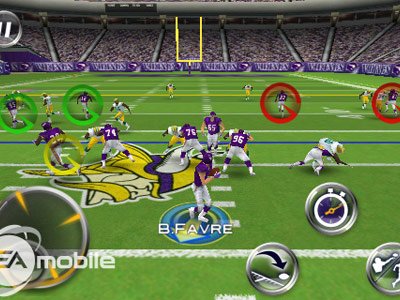
The best football game for the iPhone, Madden 2010 provides a miniaturized version of the game, you know the game consoles of the year.
We have hours of time to play this game lost, especially like how it takes advantage of the touch screen of the iPhone. Our only complaint: It's easy.
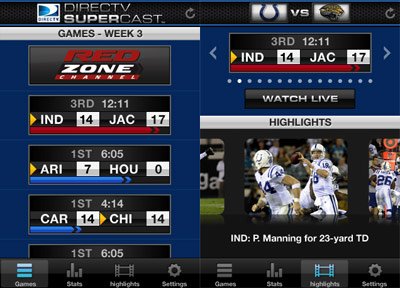
DirecTV SuperFan
DirecTV live football video offers iPhone with this new application. Note: The application is free, but the service is very expensive: You must be a subscriber to DirecTV, pay $ 300 for the NFL Sunday Ticket, and another $ 100 for the SuperFan service. But if you already do, the iPhone app is an obvious add-on.
This application is also available for the Palm Pre and select BlackBerry and Windows Mobile devices.
CBS broadcast on live college games - a football and basketball a week - for the iPhone with its new CBS Sports: College application.
Streaming video over 3G and Wi-Fi.
MLB At Bat
The best application of live sporting events of all is still in Major League Baseball stick to the iPhone, which better and better with the approach of baseball playoff series.
This year, added the match live radio link and video channels on demand, and recently allowed users to purchase live broadcasts individual games for $ 0.99 each. The league also offers a BlackBerry application.
ESPN Radio
New ESPN Radio app offers live broadcasts over 15 ESPN Radio stations across the country, including live broadcasts of college football.
ESPN Zoom Deluxe
The same set of "photographic hunting" are used to playing in a sports bar, but on your iPhone. ESPN and EpicTilt.
NFL App for Sprint
Sprint customers - no iPhone, but Palm Pre and BlackBerry - can access a single application Sprint NFL, including video streaming live NFL Network, and radio live NFL games.
Sprint says that more than 1.5 million subscribers have downloaded.
Ne mogu VAM Reci sa Sto sigurnoscu 2015 trgovini u ima za novim cameraman, Ali mozemo VAM Dati nase najbolje pogoditi - i mislimo da SMO prikovani nekoliko kljucnih Story More.
SMO Prikupili glasine, tip-off i iz brojnih gađanja uglednih Izvor i kombinirati to s Nasim vlastitim istrazivanjima i iskustvu proizvesti description curent mislimo order vidjeti u da SMO 2015.
Od actuators njih su Prilicno predvidljiva azuriranja postojecih cameraman. Većina fotoaparati imaju fiksni skirt trajanje u dometu nekog Board, a SMO mi je na proveo Neko locale proslih analysis Pokrece da Rade ekipa Next Ono Sto.
Ali, mi također znamo Sto tehnologija CAMERA AKERI koristiti, curent su ga i kako bi koristiti to moglo Biti prilagođen novim modelima. Brother i Kada za znamo sigurno Sto ne ce odluka raditi, mi znamo Sto ... i need a raditi Emer mogućnosti ima za kamere Nove Sinhyon mozda You are not logged mislili.
Konačno, tu su i neke lude, Samo, Kue glasine Sinhyon moĹĽe Biti istina. Mi SMO ucinili nase istrazivanje da vidi da li su te stvari tehnicki moguće, bilo da ste učinili poroda Biti ili koliko mogu provedene Oni.
Dakle, sjednite Spaainish, kopcin gore i drzite cvrsto dok se, Kue SMO trails kroz cameraman mislimo moĹĽe year 2015. Rating Doci u ...
Most professional photographers choose a full frame DSLR over any other camera type. They're larger, heavier and certainly more expensive than APS-C format DSLRs, but for full frame fans they're worth it.
Full frame DSLRs aren't just for pros, though. Canon and Nikon make lower cost DSLRs for enthusiasts and experts who want the best possible quality but don't need (or can't afford) full-on professional cameras.
Full frame sensors are twice the size (in area) of the APS-C sensors used in mid-range and entry-level DSLRs, and this gives them a number of advantages:
For a given resolution, a full-frame sensor will have larger photosites (pixels) so you'll get better quality at higher ISOs.
But makers can also use the larger area for higher resolutions without compromising low-light performance – the Nikon D810 has 36 million pixels and the Canon 5DS will have 50 million.
The larger sensor means you use longer focal lengths, and this gives shallower depth of field and more pronounced defocus effects – perfect for portraits, sport shots and any scene where you want to tone down a cluttered background.
All this costs money, however, and not just for the camera itself – you may also need to invest in new lenses, even if you have some already. You can't use Canon EF-S lenses on its full-frame cameras, for example, and while you can use Nikon DX lenses on a Nikon FX full frame camera, they'll only work in 'DX crop' mode, which negates the advantage of the bigger sensor.
If you're not sure, you might want to take a look at some full-frame alternatives instead:
But if you're sure full format is the way you want to go, here are a few features to look out for:
Megapixels: Most full-frame DSLRs have around 20 million pixels – about the same as APS-C DSLRs, interestingly, and chosen as a compromise between resolution and overall image quality. At the top end, though, manufacturers tend to choose speed or resolution – the Nikon D4s has just 16 million pixels but shoots at 11fps, while the D810 has 36 megapixels and shoots at 5fps.
Construction: Cheaper full frame DSLRs are built to a high standard, but the pro models are built around a metal chassis and designed to survive heavy professional use over a long period of time. The D4s has a rated shutter life of 400,000 shots.
Continuous shooting speed: If you need to capture sports and action, and to shoot in really low light, you need the Canon EOS-1D X or Nikon D4s, end of story.
AF system: The cheapest cameras in this group use AF systems from the amateur DSLR market – they're perfectly adequate for relatively static or slow-moving subjects, but for action photography you're better off with the Nikon 51-point AF or Canon's 61-point AF systems, found in the more advanced models
Lens choice: When you invest in a full frame camera you're also investing in the lens and accessory system behind it. Canon and Nikon are in the lead here, and while Sony is ramping up its full frame system, most of the effort is going into its A7 compact system camera range. There are some good lenses for the Sony Alpha A99, but its future is unclear.
Price: about £2349/US$2997, body only | Megapixels: 36.3 | Autofocus: 51-point AF, 15 cross-type | Screen type: 3-2 inch, 1,229,000 dots | Maximum continuous shooting speed: 5fps | Maximum video resolution: 1080p
The Nikon D800's 36.3Mp sensor caused a big stir when it was released in 2012, offering the highest resolution of any Nikon SLR to date. While this enables superbly detailed images, you'll need to make sure your focusing skills (and lenses) can keep up, as any lack of sharpness is more obvious.
Nikon has since replaced the D800 with the D810, which keeps the same resolution but removes the anti-aliasing effect from the filter in front of the sensor (the earlier D800E offered a reduction in anti-aliasing rather than full removal).
The D810 brings a number of improvements over the D800, including a higher resolution display, faster continuous shooting (5fps vs 4fps), 33% longer battery life and Picture Control 2.0 image effects, which now include a Clarity micro-contrast adjustment and a Flat mode for maximum dynamic range – especially useful for video.
The D810 has a 51 point AF system compared to the 61 point system in the Canon 5D Mark III, but it copes admirably with tricky focussing situations. Indeed, both the AF and metering systems are identical to those in the Nikon D4s, but at a much lower price. Considering its massive resolution and advanced features, the D810 is reasonably light and the pop-up flash is a useful bonus.
Marking its re-entry into the Indian market with a bang, Olympus announced the OM-D E-M5 Mark II Micro Four Thirds (MFT) mirrorless interchangeable lens camera (MILC) in Mumbai on Thursday. An upgrade over the original OM-D E-M5 which was released more than two years ago, the OM-D E-M5 Mark II will be available in retail stores and e-commerce websites for Rs. 74,990 (body-only).
Olympus was the first in market to introduce the 5-axis sensor-shift optical image stabilisation (OIS) system with the original OM-D E-M5 and Sony recently followed suit with its which also includes a similar OIS system. At the launch, the Japanese company continued to play up the presence of the 5-axis sensor shift IS, which can move vertically, horizontally, roll, pitch and yaw, in the OM-D E-M5 Mark II as well. The video recording quality has been upgraded drastically to allow for shooting 1080p video at 77Mbps bitrate and coupled with the IS system shakes can also be drastically reduced.
The OM-D E-M5 Mark II uses a 16-megapixel Live MOS sensor, a TruePic VII image processor and an upgraded 81-point autofocus system. It also includes a 3-inch variangle touchscreen LCD and an electronic viewfinder as well. Another interesting feature is the addition of a 40-megapixel high-resolution shot mode where camera stitches together eight images captured by shifting the lens by half a pixel step eight times. Additionally, an entire range of high-quality M.Zuiko lens is available for the OM-D E-M5 Mark II.
Speaking at the launch, Marc Radatt, General Manager, Olympus Corporation Asia Pacific said, "India is a very important market for us and we expect to have 10-15 percent market share in this mushrooming segment."
TowerJazz has won a contract from Corp to produce infrared sensors for Intel's 3D cameras, the Israeli chip manufacturer said on Tuesday.
Terms of the deal were not disclosed, but a market source who asked not to be named estimates that the agreement could be worth hundreds of millions of dollars within four years.
The 3D cameras installed on laptops recognise gestures, enabling users to control their computers with hand and head movements.
The technology was developed by Intel's Israeli subsidiary close to TowerJazz's manufacturing plant in northern Israel.
Avi Strum, general manager of TowerJazz's CMOS image sensor business, said the technology has numerous potential uses, such as the ability for the likes of cooks or car mechanics to operate a computer with gestures rather than having to touch it with dirty hands.
The camera can also capture images of an object and quickly create a model for use in 3D printing.
"Intel sensing solutions will bring consumers new experiences and will change the way people capture and share images," Strum said.
"That Intel chose us for mass production of such sensors is very positive."
While gesture control is most common in laptops or gaming systems, it is expected to become more widely used in mobile devices such as smartphones.
Canon Inc plans to buy network video surveillance leader Axis AB for about 23.6 billion Swedish crowns ($2.83 billion, roughly Rs. 17,568 crores), the biggest purchase ever for the Japanese company that is trying to expand beyond the shrinking camera market.
Canon said it was launching a tender offer to buy all Axis shares for 340 crowns each, a premium of nearly 50 percent to their closing price of 226.90 on Monday. At 1008 GMT, shares of Axis were up 48 percent at 336.70 crowns.
The Swedish company said its board of directors unanimously supported the offer, and that three of its top shareholders representing around 40 percent of total shares will accept it.
already sells surveillance cameras and sees the sector as a growing market, although it has not disclosed how much it earns from such products.
The deal will make Canon a top player in the video surveillance market, which was worth an estimated $15 billion (roughly Rs. 93,120 crores) at the end of last year, according to researcher IHS. Within that market, there is a $3.86 billion (roughly Rs. 23,962 crores) segment for network-connected security cameras which is led by Axis with a 17.5 percent share as of 2013.
The deal comes after Canon late last month reported a slight increase in fourth-quarter profit, as a weaker yen and rising sales of office equipment offset weakness in a camera division competing with smartphones capable of high-quality imaging.
The company, which earned over 80 percent of its revenue overseas in 2014, said it would pay in cash.
Axis' is targeting average annual growth of at least 20 percent and a profit margin of at least 10 percent. The company reported a fourth-quarter operating profit of 199 million crowns, slightly below analyst forecasts but up from 166 million a year earlier.
Around half of its sales come from the Americas, 40 percent from Europe, the Middle East and Africa, and the rest from Asia.
Axis said it will remain as a separate legal entity within Canon, and that its current management team will stay.
Samsung on Thursday pulled the wraps off its latest mirrorless camera in the NX range - the NX500. This camera, an upgrade to the , has a 28-megapixel APS-C-size BSI-CMOS sensor with 4K video recording capability. states that the NX500 will be available for $799.99 from March 2015 and come bundled with 16-50mm F3.5-5.6 Power Zoom ED OIS lens.
The 3-inch Super-AMOLED touchscreen can flip 180-degrees hence enabling users to take selfies at a whopping 28-megapixel resolution. Samsung adds the new DRIMeV imaging processor inside the NX500 and claims that it is much faster than the predecessor. It can shoot UHD (4096x2160 pixels) video and the captured video is compressed in H.265 format. The NX500 can also shoot images in RAW format.
With respect to the connectivity features, the NX500 packs Wi-Fi, Bluetooth and NFC for sharing photos directly with connected smartphones/tablets/computers. Samsung offers HDMI and USB ports for displaying and sharing photos using cables. The NX500 will be offered in three colours - white, black and brown. It features a faux leather finish which is similar to what we've seen in some of Samsung's smartphones. The NX500 has dimensions of 120x64x43mm and weighs 370g. Samsung claims that the battery inside the camera can last 370 shots on single charge.
Talking at the launch Sangmoo Kim, Senior Vice President of IT and Mobile Communication, Samsung Electronics said, "The compact size of the NX500 and its revolutionary shooting and focus speed allows consumers to enjoy superb image quality. We're redefining what is possible for people who aren't professional photographers, and offering everyone the ability to capture their signature moments in every shot."
Notably, the first Tizen-based was the NX300M back in November 2013. We can only speculate at the moment if Samsung will launch a NX500M running Tizen OS, in the near future.
It's not been even a month that Canon showed of in its PowerShot range, and we already have news about the launch of two more cameras - PowerShot SX410 IS and PowerShot ELPH 350 HS. Additionally, the Japanese camera giant also teased the existence of the PowerShot G3 X, a premium point-and-shoot with a 1-inch sensor.
The $280 (roughly Rs. 17,000) PowerShot SX410 IS is expected to hit the markets in March. This super-zoom bridge camera is a direct upgrade to the PowerShot SX400 and boasts of a 40x optical zoom lens. It has a 20.2-megapixel CCD sensor. Unlike the PowerShot cameras revealed at in January, the PowerShot SX410 IS doesn't have Wi-Fi or NFC pairing mode. Also, the video recording resolution tops off at 720p, which is surprisingly low.
Featuring a more compact design, the PowerShot ELPH 350 HS has a 20.2-megapixel CMOS sensor. It is priced at $210 (roughly Rs. 12,900) and is expected to go on sale in April. It has a 12x optical zoom lens with an intelligent image stabilisation system. Additionally, it also has Wi-Fi and NFC connectivity built in, and it can shoot 1080p videos.
Details about the PowerShot G3 X are scant but is definitely working on it, and is expected to divulge more details about it at the CP+ event next week. It has a 1-inch CMOS sensor like we mentioned earlier, apart from a 24-600mm focal range and a 25x optical zoom lens.
Pushing the boundaries of portable storage, SanDisk has unveiled a new microSDXC memory card with an astonishing 200GB capacity. This is particularly impressive because SandDisk has continued to push more and more gigabytes onto a storage medium that is the size of the average human fingernail.
It's interesting to note that despite paying the cost of an average smartphone ($400) for the SanDisk 200GB Ultra microSDXC UHS-1 Premium Edition card, users may not actually be able to use it with anything just yet. Most devices that support microSD are rated to support up to 128GB cards for the time being, including the just unveiled . The new does not even support expandable storage, departing from Samsung's typical strategy of flagship phones supporting microSD cards. SanDisk rates the card speed at 90MB/s, which means that it will take in excess of 30 minutes to actually fill it up with data.
Also launched by SanDisk is a new 32GB dual-USB drive with a reversible Type-C USB 3.1 connector, and one USB 3.0 connector. Again, here isn't anything you can actually connect the Dual USB Drive to, with Type-C compatible phones and tablets expected to launch in the coming months. Whenever they do, this card will keep you ready though, and in the meantime, you can always use the regular USB plug to connect it to the vast majority of computers available in the market.
Neither of these products are actually launching just yet, with SanDisk just content to showcase the fact that it's ready with the next generation of products. Both will be available in the coming months, with the Type-C USB drive also expecting storage capacities higher than 32GB.
SanDisk has also revealed a new 128GB version of its popular iXpand Flash Drive range, designed to quickly transfer pictures and video from iOS devices to Mac computers or PCs. There are also updates to the iXpand Sync app, which now supports Apple's Touch ID fingerprint sensor on the new iPhones and iPads. The new 128GB capacity costs $150 (roughly Rs. 9,300) and is already retailing via Sandisk.com.
Camera maker India on Wednesday said it is optimistic about the Indian market and is aiming at 16 percent growth in its topline in 2015.
"We had a topline of Rs. 2,026 crores in 2014 despite odds, representing a six per cent expansion over the last year. Revenue from both B2C (business to customer) and B2B ((business to business) was almost similar," Canon India president and CEO Kazutada Kobayashi said.
"In 2015, we are aiming at 16 percent growth in the topline," he said.
In the consumer segment, compact volumes had shrunk by 30-35 percent, but at the same time SLR and DSLR segment was growing, a trend which may continue for some time, the Japanese company said.
(Also See:)
Canon is also focusing at value-added services like document management service providing from being a printing hardware seller.
Kobayashi said Canon had also forayed into commercial printing space in its aim to expand in the country.
He said Canon is open to acquisitions in software space in the global market including India to fuel its management services.
Moving in sync with technological advancement, Hyderabad Traffic Police (HTP) would soon procure 100 'Body Worn Cameras' to be used during enforcement work under its 'Smart Policing' initiative.
"As of now, traffic cops are using four wearable video cameras on an experimental basis. Orders have been placed for 100 more sophisticated GPRS-enabled body wear cameras. Sub-inspectors (in traffic police) will be using them by March end," Additional Commissioner of Police (Traffic), Jitender, told reporters in Hyderabad on Tuesday.
Briefing on the system, he said the high resolution audio-visuals will be recorded in the camera and stored in a memory card. Feeds can be seen live from the police control room through 4G technology.
"This would facilitate socially desirable behaviour. Use of wearable video cameras can bring measurable benefits to relation between police and the civilians," he said.
Each body camera costs Rs. 1,50,000 and is effective during night as well.
Meanwhile, payment for a record number of 10,000 pending challans for traffic violations was made on Monday as part of the 'Cashless Enforcement in Traffic Management' and fine to the tune of Rs. 19,00,000 was collected, the senior officer said.
Under the 'cashless enforcement' initiative, police have discontinued the practise of collecting cash for traffic 'challans' (a receipt for payment) on the spot. Instead, violators are asked to pay penalties online and through other modern modes.
Telangana government has sanctioned Rs. 21 crores for modernisation of Hyderabad Traffic Police, he said, adding, this amount will be utilised for setting up 'Automatic Integrated Traffic Management System'.
"The proposed system will focus on stop-line violation, red signal jumping, wrong side movement and detect over-speeding and issue e-challan to the violators," he said.
Modern signage boards and interceptor vehicles with 360 degree cameras to detect violations are among the new initiatives planned, he added.
As part of citizen friendly initiatives, only officers above SI rank are authorised to stop vehicles for checking documents during enforcement work, while lower rank officer are only allowed to record traffic violation by using electronic evidence, he said.
Looks like Canon has not limited itself to launching cameras in its PowerShot range. The Japanese camera major has pulled the wraps off the Canon EOS 5DS and EOS 5DS R with 50.2-megapixel sensors each, thus making them the world's highest-resolution full-frame DSLRs. Canon also introduced EOS Rebel T6s and Rebel T6i, which enter the top end of its entry-level DSLRs.
The EOS 5DS and the EOS 5DS R are priced (body-only) at $3,700 (roughly Rs. 2,28,500) and $3,900 (roughly Rs. 2,40,900) respectively, and are expected to hit the shelves in June. Similarly, the Rebel T6s is priced at $850 (roughly Rs. 52,500) body-only or $1200 (roughly Rs. 74,100) with EF-S 18-135mm kit lens, and the EOS Rebel T6i will retail for $750 (roughly Rs. 46,300) body-only, $900 (roughly Rs. 55,600) with EF-S 18-55mm kit lens.
Both the Canon EOS 5DS and the EOS 5DS R cameras have a Dual DIGIC 6 image processor and feature a 61-point autofocus system. The chassis design has now been improved to minimise camera shake. There are some cool software features as well, like a built-in time-lapse filter and up to 5fps high-speed continuous shooting. Wireless connectivity options like Wi-Fi and NFC are also present. Unfortunately, both the cameras can only shoot 1080p HD video and the lack of 4K video recording is a let-down according to us. The only difference between the two cameras is that the Canon EOS 5DS R doesn't have a low-pass filter, which effectively removes anti-aliasing for sharper images.
On the other hand, the Rebel T6s and Rebel T6i both have a 24.2-megapixel APS-C sensor and use Digic 6 processors each. The T6s is the flagship camera of the two and it has an additional LCD panel and a quick control dial. Both the cameras can capture 1080p video at 60fps and have a high dynamic range movie recording mode. Also, Canon finally adds Wi-Fi and NFC connectivity options to the Rebel series with these cameras.
Ever fancied a 3D selfie of yours? Well, that's perhaps going to be the next cool thing in the realm of selfies.
Dusseldorf-based can produce a detailed, four-inch figurine of your body, or in other words, a 3D selfie, Wired.com.
Making one of these figurines requires a massive pile of hardware and software - 54 DSLRs, 54 lenses, a complex 3D modelling pipeline, and an $80,000 full-colour 3D printer, not to mention a room-size scanning booth.
The company has four 3D scanning booths (called "Doob-licators") scattered in strategic locations throughout the world.
There's one in Dusseldorf, one in Tokyo, one at Santa Monica Place in Los Angeles, and one in New York City's Chelsea Market. The DOOB shop in New York has been a pretty big hit.
The Doob-licator saw about 500 customers over the winter holiday season, Michael Anderson, CEO of DOOB 3D USA, was reported as saying by Wired.
About 10 percent of the booth's customers got their pets Doob-licated.
"At first, (people got DOOBs made) mostly on a whim. Now, at least two thirds of our customers have planned ahead to get a DOOB," Anderson said.
Each Doob-licator is outfitted with 54 Canon EOS Rebel T5i DSLRs, arranged in nine columns of six cameras each.
(Also See:)
A customer steps in, strikes a pose, and the Doob-licator operator fires all the cameras at once. That creates a full-body scan in a fraction of a second.
The next step involves feeding all those 18-megapixel images through the company's proprietary software, which creates a 3D model of the subject.
The process requires more patience. A high-resolution laser-sintering 3D printer uses a resin polymer material, and the full range of CMYK colour is added to each powder layer as it's printed.
With a top printing speed of 1.1 inches per hour and a process that sometimes involves thousands of layers of powder, the process takes a few hours for the smallest-size DOOB and half a day or more for the larger ones.
A life-size statue can cost up to $75,000 (roughly Rs. 46 lakhs).
Transcend has launched two car video recorders, dashboard cameras or dashcams, in India. The DrivePro 100 and DrivePro 200 have been priced at Rs. 8,999 and Rs. 9,899 respectively. The cameras are already available via Amazon and Snapdeal.
The Taiwanese manufacturer, best known for its storage offerings, says the dashcams are a "safety solution on the road". cites changing lifestyles and increasing traffic levels resulting in more road accidents.
The Transcend DrivePro 100 dashcam is the standard model with a large f/1.8 aperture and a six-glass 130-degree wide angle lens. It features a 3-megapixel CMOS sensor with low-light sensitivity, and comes with a built-in speaker and microphone. The DrivePro 100 features a 2.4-inch LCD display with an unspecified resolution.
The DrivePro 200 on the other hand features an f/2.0 aperture and a seven-glass (and one infrared filter) 160-degree wide angle lens, and Wi-Fi connectivity for controlling the camera and also for easier syncing of recorded videos with mobile devices. It also features a 3-megapixel CMOS sensor with low-light sensitivity, apart from a built-in speaker and microphone, and a 2.4-inch LCD display with an unspecified resolution.
Transcend says both the DrivePro 100 and DrivePro 200 car video recorders are capable of recording at full-HD resolution at 30fps. The firm is touting automatic adjustment to different lighting conditions to ensure all details are captured. Both also feature 3-axis G-sensors for emergency recording activation on impact.
A free DrivePro PC Tool for Windows can be downloaded to play recorded videos. Android and iOS apps are available for the DrivePro 200, allowing users to watch live footage while recording, to play back and download videos, and to adjust camera settings.
Powered via the car adapter for the cigarette lighter socket, both dashboard cameras also sport built-in Li-polymer batteries, so that if the car loses power they can still record important information for up to 30 seconds. Alternatively, the cameras can be manually activated to record up to 30 minutes without a power supply. Both cameras come with a 16GB microSDHC card bundled. Both cameras also feature an adhesive mount in the box, but a suction mount can also be purchased separately.
Nasa's Curiosity rover has clicked a selfie showing the vehicle at the "Mojave" site on the Red Planet where its drill collected the mission's second taste of Mount Sharp.
The latest self-portrait shows a sweeping view of the "Pahrump Hills" outcrop on Mars where Nasa's has been working for five months.
The scene is assembled from dozens of images taken by the Mars Hand Lens Imager (MAHLI) camera on the rover's robotic arm.
"Compared with the earlier Curiosity selfies, we added extra frames for this one so we could see the rover in the context of the full Pahrump Hills campaign," said rover team member Kathryn Stack at Jet Propulsion Laboratory, Pasadena, California.
"From the Mojave site, we could include every stop we have made during the campaign," he added.
Pahrump Hills is an outcrop of the bedrock that forms the basal layer of Mount Sharp, at the centre of Mars' Gale Crater.
The mission has examined the outcrop with a campaign that included a "walkabout" survey and then increasingly detailed levels of inspection.
The rover climbed from the outcrop's base to higher sections three times to create vertical profiles of the rock structures and chemistry, and to select the best targets for sample-collection drilling.
The component images for this self-portrait were taken in late January, while Curiosity was at a drilling site called "Mojave 2".
At that site, the mission collected its second drilled sample of Pahrump Hills for laboratory analysis on Earth.
Nasa's Mars Science Laboratory Project is using Curiosity to assess ancient habitable environments and major changes in Martian environmental conditions.
Exactly a year after Olympus introduced its stylish compact camera Stylus SH-1, the camera manufacturer has gone ahead and launched its successor the Stylus SH-2. The Olympus Stylus SH-2 is not too different from its predecessor apart from the fact that it has support for shooting RAW images and time-lapse movies, and also brings a 'live composition' feature apart from nightscape modes. It is expected to go on sale next month for a price tag of $400 (approximately Rs. 25,000).
The Sylus SH-2 has a 1/2.3-inch BSI CMOS sensor with a 24x optical zoom lens. The lens can also go as wide as 24mm. The one thing unique to the Stylus SH-2 when compared with other compact cameras - which is also a feature the camera has retained from its predecessor - is the mechanical 5-axis image stabilisation system. This IS system should help users take stable shots in low-light conditions. The camera can also shoot 1080p videos at 60fps. There's a 3-inch touchscreen LCD with a 460k-dot resolution on the rear of the Stylus SH-2. The addition of Wi-Fi capabilities to the camera is an added advantage but the lack of NFC is a bit of a letdown.
Design-wise the camera looks like the more expensive, more feature-rich, more powerful PEN range of interchangeable lens cameras. The entire body is mostly made of an aluminium alloy and a sheet of leather stitched to the front, which makes it look retro. In case you were wondering, the Stylus SH-2 has dimensions of 109x63x42mm and weighs 271 grams.
You might have thought it would all be mobile phones today considering Mobile World Congress has started in Barcelona, but Nikon has bucked the trend with an announcement of its own.
It will be launching the Nikon D7200 DX-format DSLR camera on 19 March and it has the distinction of being the company's first in that category to feature NFC and Wi-Fi connectivity built-in.
Other specifications include a 24.2-megapixel sensor with EXPEED 4 processing. There is a 52-point autofocus system and the camera is capable of an ISO range of 100 - 25,600.
It can shoot up to six frames per second in DX format, but up to seven fps in 1.3x crop. And up to 27 12-bit RAW images can be captured in one high speed burst (up to 100 high-quality JPEGs).
It can record video in Full HD at up to 25/30fps in DX format, but up to 50/60fps in 1.3x crop mode. And the rear sports a 3.2-inch 1,229k-dot RGBW LCD monitor.
A built-in i-TTL flash is included on the model, which also comes with two SD card slots inside that support SDXC and UHS-i cards.
The on board Wi-Fi works with Nikon's Wireless Mobile Utility for iOS and Android. You can share photos from the camera to a smartphone or tablet this way. And you can even use your smart device to remotely capture images on the D7200. The NFC tech means you can easily pair your camera and compatible smart device by just tapping them together.
The Nikon D7200 will be available for £940 for the body only, £1,120 for the camera and an included Nikkor 18-105 VR lens.
Nikon has unveiled a fixed lens camera superbly suited to wildlife and night sky photographers as it comes with a mighty 83x optical zoom. That means it is capable of capturing details that can't normally be seen by the naked eye.
The zoom of the Nikon Coolpix P900 can even be enhanced digitally to 166x - great for sporting events perhaps. It also has 5.0-stop Dual Detect Optical VR technology to prevent shake and shudder, which is vital when shooting at extreme zoom.
Inside there is a 16-megapixel CMOS image sensor and an EXPEED C2 processor.
GPS/GLONASS/QZSS support is present to location stamp photos and video. Plus, Wi-Fi and NFC are built in to help you share images to a smartphone or tablet - iOS and Android apps are available.
The 3-inch LCD monitor on the rear is vari-angle so can be moved to give the best view. And there is an electronic viewfinder on the body that automatically switches from rear screen to the eye piece when looked through.
The camera is capable of shooting video in Full HD and at up to 60 frames per second. Timelapse movies can be shot too.
The on board microphone has zoom capabilities too and there are dedicated modes on the camera for shooting subjects such as the moon or birds.
Nikon is also including 20GB of online photo space with the P900 at Nikon Image Space.
The Nikon Coolpix P900 costs £500 and will be available from 19 March.
Movie remakes, they're all the rage at the moment. Take a perfectly good flick and recreate it, often scene for scene. Which is a bit like the Olympus Stylus SH-2 compact camera: it's a carbon copy of its SH-1 predecessor from last year, adding only a new Nighscape shooting mode for low-light scenes and, nope, that's your lot.
The SH-2 is a camera targeted at those wanting ample zoom, here a 25-600mm equivalent, and a decent stabilisation system - with Olympus' 5-axis system among the best of the type on the market. With stabilisation active you'll be able to get away with handheld capture at slower shutter speeds in low-light conditions.
Taking design cues from the OM-D range, the SH-2 also looks the part, especially for those seeking a retro style in a modern body. The 24x optical zoom isn't as significant as , and Olympus hasn't shied away from a bit of added bulk either - the SH-2's 42.4mm depth is chunkier than the TZ70's 34.4mm measure. But then the Olympus is the better looking of the pair.
Compose images on the rear 3-inch, 460k-dot LCD screen, complete with touch-focus for hands-on operation, and the SH-2's 16-megapixel sensor will record images in high-resolution clarity. Or for movie capture 1080p at up to 60 frames per second is possible, which can also benefit from the 5-axis stabilisation system for extra smooth capture.
As the earlier SH-1 gets ranged out of shops, the SH-2 will be the model to grace the shelves, the original resigned to the bargain bin. But price is another crucial factor: when the SH-2 goes on sale this month its £250 asking price is a full £100 less than the SH-1 was at launch. That's a savvy price point that will help stand this Olympus out from the crowd.
The D7200 is Nikon's new top APS-C format DSLR, but while it does boast some useful improvements over the D7100 before it, it feels like a mid-term update rather than a new camera.
It's certainly no rival for the Canon EOS 7D Mark II announced last September. There's still a gap at the top of the Nikon range for a high-speed semi-pro APS-C format camera – the D400? – but still no sign that Nikon's going to make one.
Instead, the D7200 is more likely to appeal to enthusiasts and non-professionals, just like the Canon EOS 70D.
It's been two years since the D7100 was launched, and on the face of it the D7200 brings few major changes. Externally, it's identical, with the same dimensions, weight, rear screen and viewfinder.
The sensor looks like the same 24-megapixel OLPF-free unit found in the D7100, though there are signs that some details have changed. Nikon quotes a resolution of 24.2 megapixels, versus the 24.1 megapixels of the D7100, though the final image size is exactly the same at 6,000 x 4,000 pixels.
Whether or not the sensor has been re-developed, the camera's internal processor has certainly been upgraded. The D7100 used an Expeed 3 processor, while the D7200 swaps to Expeed 4.
Normally, a processor upgrade brings improvements in continuous shooting speeds and high-ISO capability, and the latter has certainly improved. The D7200 now has a native ISO range of 100-25600, which is 2EV higher than the ISO 100-6400 of the D7100. The D7100 goes up to ISO 25600 in expanded mode, but the D7200 can pull this trick too, offering a Hi2 setting of 102400.
The D7200's continuous shooting speeds are the same as the D7100's – 6fps at full resolution and 7fps in the camera's 1.3x 'crop' mode. This is a little disappointing, but the D7200 has addressed a serious weakness in the D7100 – its small buffer capacity. Nikon now quotes a capacity of 27 RAW files or 100 JPEGs in a burst, which is much better – though the RAW figure is for smaller 12-bit NEF files, not the 14-bit files most photographers would choose for outright quality.
This was introduced with the D7100, and it does a couple of things. First, it extends the reach of telephoto lenses, and the 24-megapixel OLPF-free sensor has enough resolution to handle cropping pretty well.
Second, it allows the 51 AF points to completely fill the frame. In fact, this is another area where Nikon has made slight improvements. It's the same Multi-CAM 3500 II used in Nikon's pro DSLRs, and has improved low-light sensitivity, now working in light levels half as bright as before, down to -3EV.
The AF sensor also has 15 cross-type sensors and one central sensor that can work down to apertures as low as f/8 – this opens up the use of telephoto lenses and teleconverters.
This is the term Nikon uses for its picture styles when you shoot JPEGs or movies, and it's been steadily rolling out the new version over its whole camera range.
The D7100 now offers seven different Picture Controls and incorporates a new Clarity adjustment for boosting micro-contrast. There's also a new Flat mode which offers reduced contrast and maximum dynamic range. This is more likely to interest video users rather than stills photographers because it gives more scope for grading and enhancing footage later – in video, there's no equivalent of raw files.
The D7200 is compatible with a new ME-W1 wireless mic from Nikon, which it's claimed enables you to capture sound from up to 50m away. You can save footage to the D7200's dual card slots or send it via HDMI to an external recorder.
It shoots 1080 footage at 30/25p but, interestly, if you want to shoot at 60/50p for slow-motion, you have to do it in the 1.3x crop mode.
Nikon says the D7200 also offers a time-lapse feature with smooth exposure transitions and the ability to shoot light trails with continuous shooting at shutter speeds of 4 seconds or slower that won't stop until your memory card fills up.
The D7200 also incorporates Wi-Fi and – for the first time in a Nikon DSLR – NFC communication. We look forward to trying these features out just as soon as we can get one in for review.
The D7200 will cost £940/US$1200 (about AU$1540) body only, or £1120 with the Nikon 18-105mm VR kit lens in the UK, US$1700 (about AU$ 2180) with the Nikon 18-140mm kit lens in the US. It goes on sale on March 19 2015.